
Program 02
Prescription · Requires ConsultationPeptide Therapy
Written by the Elevate Clinical Team
Medically reviewed by Dr. Eric W. Anderson, MD · Last reviewed
Citations independently verified against PubMed, ClinicalTrials.gov, and FDA sources on .
Understand the signals behind your recovery.
Peptides are short chains of amino acids that can influence biological signaling — including repair, inflammation, sleep and hormone release. This page explains the science and separates physician-supervised care from research-use products. If a treatment is clinically appropriate, a physician evaluates your history, goals and bloodwork before discussing any legally available option.
Every vial we prescribe passes six documented checkpoints.
The lot number on your vial links back to every document created along the way. See the full chain of custody →
Who it's for
- Athletes and operators carrying heavy training or travel load
- Anyone recovering from injury, surgery or chronic overuse
- High performers whose sleep quality has quietly degraded
- Patients who want lean mass preserved through body-composition change
What's included
- 65-biomarker baseline panel drawn at Quest near you
- Physician discussion of whether any therapy is clinically appropriate
- Education on administration, monitoring and potential risks
- Individualized follow-up based on symptoms and lab results
- Repeat labs at Quest and clinical reassessment when indicated
What changes
- A clearer understanding of the biology behind recovery and performance
- Objective tracking of sleep, body composition and tissue health
- A risk-aware plan aligned with your clinical history
- Ongoing decisions based on measured response, not hype
Educational reference
The science behind the conversation.
The names below describe areas of clinical and scientific interest and do not guarantee availability. Elevate Chicago separates physician-supervised treatment from research-use products. A physician determines what, if anything, is appropriate for care after reviewing your history, goals and labs.
Important sourcing & research notice
Hormone therapy is prescription care. Every hormone we prescribe is dispensed through an appropriately licensed compounding pharmacy, and we use FDA-approved medications for their approved indications when applicable. FDA-registered 503B outsourcing facilities may be used when applicable. Pharmacy status, formulations and availability can change as federal and state requirements change.
When a suitable prescription formulation is not legally available through a compounding pharmacy, certain compounds may be offered separately by Elevate Chicago strictly for lawful laboratory or research use. These products are not FDA-approved medications, are not prescribed or dispensed as medical care, and are not intended for human or animal consumption or for the diagnosis, treatment, cure or prevention of disease. Buyers are responsible for using them only for lawful research and for complying with all applicable requirements. Nothing on this page is medical advice or a substitute for a physician evaluation.
Growth hormone secretagogues
Sermorelin
Growth-hormone-releasing hormone analog studied in sleep and recovery
Read the one-pagerCOMPOUNDED — NOT FDA-APPROVEDIpamorelin
Selective growth-hormone secretagogue studied in recovery protocols
Read the one-pagerCOMPOUNDED — NOT FDA-APPROVEDCJC-1295 (with or without DAC)
GHRH analog studied for its effect on growth-hormone signaling
Read the one-pagerFDA-APPROVEDTesamorelin
GHRH analog studied for effects on visceral adipose tissue
Read the one-pagerNOT FDA-APPROVEDMK-677 (Ibutamoren)
Investigational oral compound studied for appetite, sleep and lean mass
Read the one-pagerRepair & recovery
BPC-157
Research interest in tendon, ligament, muscle and GI-lining repair
Read the one-pagerNOT FDA-APPROVEDTB-500 / Thymosin Beta-4
Research interest in healing, flexibility and scar remodeling
Read the one-pagerNOT FDA-APPROVEDBPC-157 + TB-500 stack
A research combination discussed in acute-injury and post-operative contexts
Read the one-pagerNOT FDA-APPROVEDGHK-Cu
Research interest in collagen, skin quality and connective-tissue remodeling
Read the one-pagerNOT FDA-APPROVEDKPV
Investigational anti-inflammatory signaling research involving gut and skin
Read the one-pagerNOT FDA-APPROVEDLL-37
Investigational antimicrobial and inflammatory-balance research
Read the one-pagerNOT FDA-APPROVEDPentadeca Arginate (PDA)
Research interest in a BPC-related analog and tissue repair signaling
Read the one-pagerSleep, cognition & neuro
DSIP (Delta Sleep-Inducing Peptide)
Investigational research into slow-wave sleep architecture
Read the one-pagerNOT FDA-APPROVEDSelank
Investigational anxiolytic and stress-response research
Read the one-pagerNOT FDA-APPROVEDSemax
Investigational focus, memory and cognitive-endurance research
Read the one-pagerNOT FDA-APPROVEDDihexa
Investigational synaptic-support research
Read the one-pagerNOT FDA-APPROVEDCerebrolysin
Neurotrophic-support research in select clinical contexts
Read the one-pagerMetabolic & body composition
AOD-9604
Investigational research into fat-metabolism signaling
Read the one-pagerNOT FDA-APPROVEDMOTS-c
Investigational mitochondrial and insulin-sensitivity research
Read the one-pagerNOT FDA-APPROVED5-Amino-1MQ
Investigational NNMT-inhibition and body-composition research
Read the one-pagerLongevity & immune
Epitalon
Investigational circadian and pineal-axis research
Read the one-pagerNOT FDA-APPROVEDThymosin Alpha-1
Immune-modulation research and approved use varies by jurisdiction
Read the one-pagerNOT FDA-APPROVEDSS-31 (Elamipretide)
Investigational mitochondrial-membrane research
Read the one-pagerNOT FDA-APPROVEDHumanin
Investigational cytoprotective and metabolic-signaling research
Read the one-pagerNOT FDA-APPROVEDNAD+ / NMN
Cellular-energy research; these are not peptide hormones
Read the one-pagerHormonal signaling & sexual health
PT-141 (Bremelanotide)
Melanocortin-pathway signaling; FDA-approved bremelanotide has a specific indication
Read the one-pagerNOT FDA-APPROVEDKisspeptin-10
Investigational upstream HPG-axis signaling research
Read the one-pagerCOMPOUNDED — NOT FDA-APPROVEDGonadorelin
Gonadotropin-releasing hormone signaling studied in reproductive endocrinology
Read the one-pagerCOMPOUNDED — NOT FDA-APPROVEDOxytocin
Hormone signaling involved in labor, lactation, arousal and social bonding
Read the one-pagerFrequently asked questions.
- What is the Peptide Therapy program?
- Peptides are short chains of amino acids that can influence biological signaling — including repair, inflammation, sleep and hormone release. This page explains the science and separates physician-supervised care from research-use products. If a treatment is clinically appropriate, a physician evaluates your history, goals and bloodwork before discussing any legally available option.
- Who is Peptide Therapy for?
- It is built for athletes and operators carrying heavy training or travel load; anyone recovering from injury, surgery or chronic overuse; high performers whose sleep quality has quietly degraded; patients who want lean mass preserved through body-composition change.
- What is included?
- 65-biomarker baseline panel drawn at Quest near you; Physician discussion of whether any therapy is clinically appropriate; Education on administration, monitoring and potential risks; Individualized follow-up based on symptoms and lab results; Repeat labs at Quest and clinical reassessment when indicated. Everything is delivered virtually — the only in-person step is your blood draw at a Quest patient service center.
- What changes if the protocol is working?
- A clearer understanding of the biology behind recovery and performance; Objective tracking of sleep, body composition and tissue health; A risk-aware plan aligned with your clinical history; Ongoing decisions based on measured response, not hype. Progress is measured against your own baseline labs at follow-up, not against an average.
- How do I start, and what does it cost up front?
- Start with a free intro call or labs with a clinical-team review. From there it is a Quest draw, a video visit with your clinician, a written protocol, and ongoing monitoring with follow-up panels.
Sources
- 1.Testosterone therapy in men with hypogonadism — clinical practice guideline— Endocrine Society
- 2.Compounding and the FDA: questions and answers— U.S. Food & Drug Administration
- 3.Test directory and patient service center locator— Quest Diagnostics
- 4.Telehealth policy and licensure requirements— U.S. Department of Health and Human Services
About this page
Written by the Elevate Clinical Team
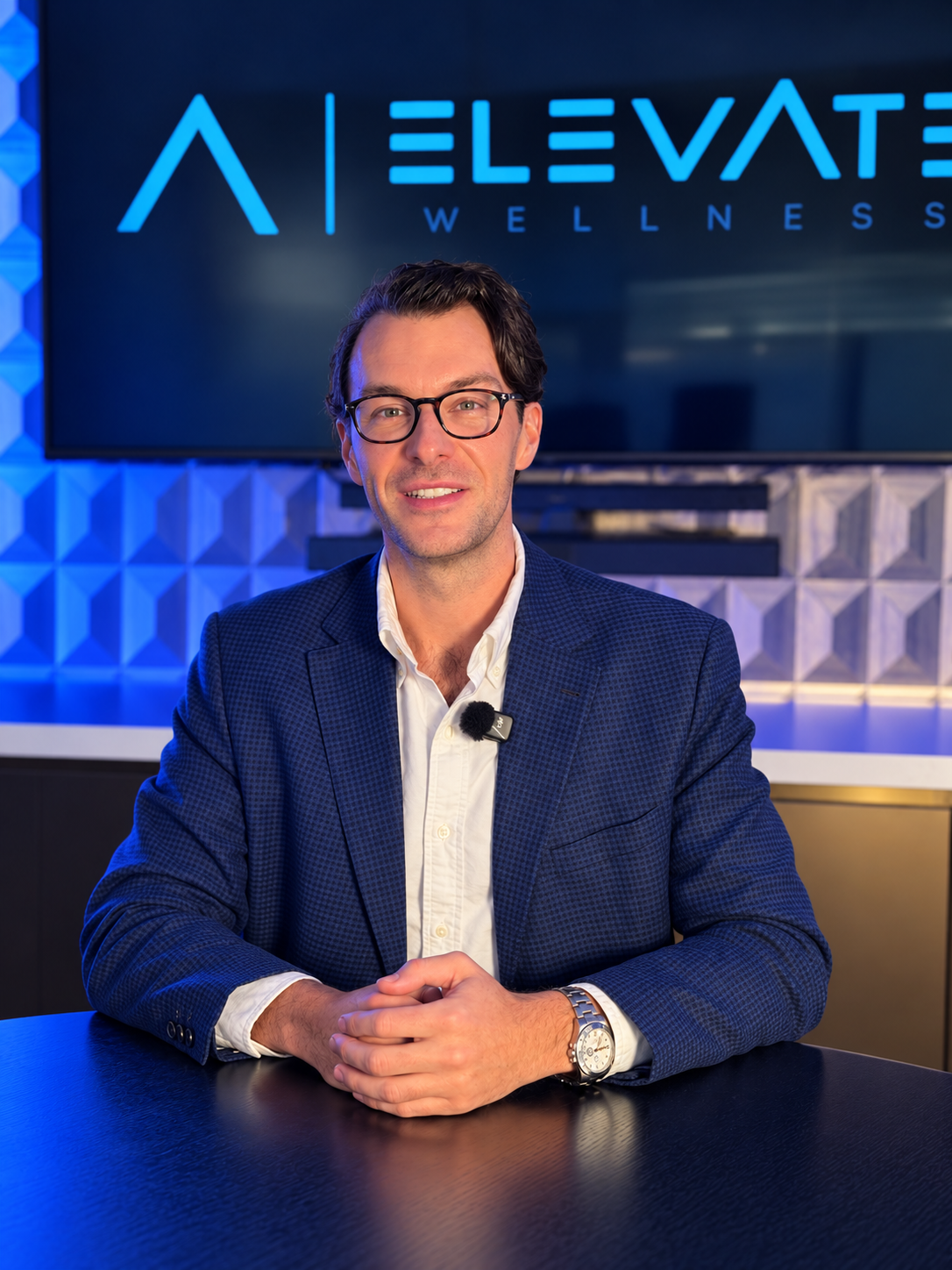
Medically reviewed by Dr. Eric W. Anderson, MD · Last reviewed . Citations independently verified against PubMed, ClinicalTrials.gov, and FDA sources on . Educational content only — not medical advice, not a diagnosis, and not an offer to sell any prescription product.
Explore
Other programs.
Hormone Optimization
The foundation. Testosterone, estradiol, progesterone and thyroid — measured properly, prescribed through a licensed compounding pharmacy, and titrated to how you actually feel.
03Prescription · Requires ConsultationMetabolic & Weight
Metabolic care that looks at your whole endocrine system first.
04Prescription · Requires ConsultationLongevity & Healthspan
Advanced biomarker panels, cardiovascular and cognitive risk mapping, and a protocol designed for the next thirty years.